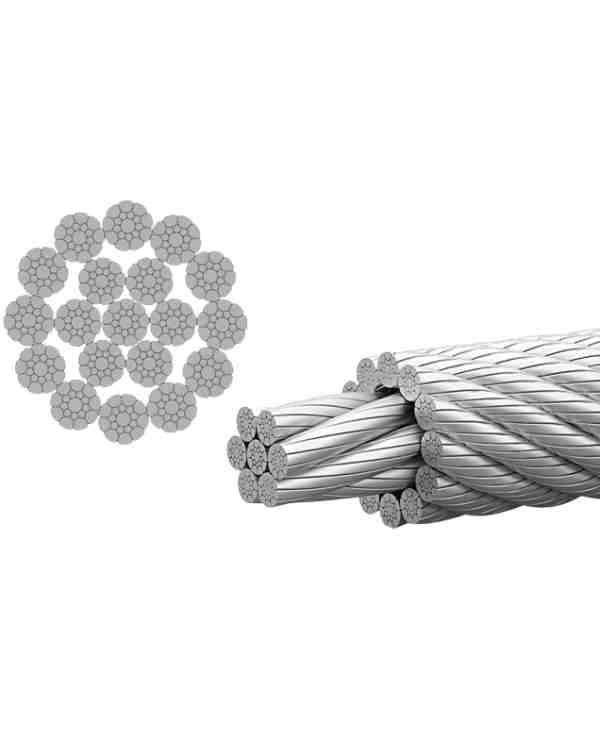
Four Leg Wire Rope Sling in Jeddah is a multi-leg lifting assembly designed for suitable construction, machinery handling, fabrication and industrial material-handling applications. The 4-Leg Wire Rope Sling with Self-Locking Eye Hook combines four wire-rope legs with self-locking eye hooks to provide multiple connection points for compatible loads.
Nassguard supplies Four Leg Wire Rope Slings in Jeddah, Riyadh, Dammam, Jubail and Al Khobar, with supply available across Saudi Arabia.
A Four Leg Wire Rope Sling is a four-leg lifting assembly used when a suitable load has several approved lifting points. Each wire-rope leg connects to a suitable point on the load, while the upper end connects to compatible lifting equipment.
The Self-Locking Eye Hook provides the connection at the load end. Its locking mechanism helps retain the hook when it is correctly engaged with a compatible lifting point.
This type of sling can provide controlled support for suitable loads with multiple lifting points. However, the four legs do not automatically carry an equal share of the load. The actual forces depend on the sling angle, load geometry, centre of gravity and position of the lifting points.
The sling should always match the load weight, working load limit, rope diameter, working length, hook capacity and lifting arrangement.
Machinery Lifting: Suitable four-leg slings can support machinery and equipment that have multiple approved lifting points.
Construction Work: Construction teams can use the sling for suitable structural components, equipment and heavy materials.
Industrial Maintenance: Maintenance teams can use four-leg wire rope slings during equipment relocation, replacement and planned maintenance operations.
Fabrication Work: Fabrication workshops can use suitable sling assemblies for moving steel structures, frames and fabricated components.
Plant Operations: Manufacturing and processing facilities can use compatible four-leg lifting assemblies for equipment and material handling.
Heavy Equipment Handling: A four-leg configuration can suit suitable loads that require several lifting points and controlled positioning.
Material Handling: Industrial facilities can use the sling for controlled movement of suitable loads between work areas.
Workshop Operations: Workshops can use four-leg lifting assemblies for suitable machinery and component handling when the lifting plan permits their use.
Businesses in Jeddah and Riyadh can use Four Leg Wire Rope Slings with Self-Locking Eye Hooks for suitable construction, machinery and industrial lifting. In Dammam and Jubail, these assemblies can support appropriate plant, fabrication and maintenance operations. Nassguard also supplies them in Al Khobar and across Saudi Arabia.
A 4-leg wire rope sling with self-locking eye hooks provides several connection points around a suitable load. This arrangement can help control loads that have multiple approved lifting points.
The self-locking eye hooks provide a defined connection at the load end. When correctly engaged, the locking mechanism helps retain the hook connection.
The locking mechanism does not replace correct lifting practice. The hook must sit correctly on the approved lifting point, and the connection must remain suitable throughout the operation.
The sling angle also affects the force carried by each wire-rope leg. A wider angle can increase the tension in the individual legs.
Workers should therefore select the sling according to the documented working load limit and actual lifting configuration.
Before every lift, workers should inspect the wire rope, hooks, locking mechanisms and end connections. Look for broken wires, corrosion, deformation, crushing, severe abrasion or other visible damage.
The 4 Leg Wire Rope Sling Capacity cannot be calculated simply by multiplying the capacity of one sling leg by four.
Load distribution depends on the centre of gravity, lifting-point positions, sling angles and load geometry. If the load is uneven, some legs may carry more force than others.
The sling angle also affects the tension in the wire-rope legs. Therefore, users should select the sling based on the documented WLL for the actual lifting configuration.
The self-locking eye hooks must also have suitable capacity for the intended connection. Workers should assess the complete assembly rather than considering only the wire rope.
Before lifting, workers should inspect the complete Four Leg Wire Rope Sling.
Check the:
Look for broken wires, corrosion, kinks, crushing, deformation, severe abrasion and excessive wear.
The sling should remain within its documented working load limit. Never exceed the rated capacity or use a damaged component for lifting.
The hooks should also remain correctly engaged with the approved lifting points. Workers should not use an incorrectly positioned hook simply because its locking mechanism is closed.
1. What is a 4-Leg Wire Rope Sling with Self-Locking Eye Hook used for?
It is used for suitable lifting, machinery handling, construction, fabrication, maintenance and industrial material-handling operations where a multi-point lifting arrangement is appropriate.
2. What is the purpose of the self-locking eye hook?
The self-locking eye hook provides the connection between the sling leg and a compatible lifting point. Its locking mechanism helps retain the connection when the hook is correctly engaged.
3. Does each leg carry an equal share of the load?
Not necessarily. Load distribution depends on the sling angle, centre of gravity, lifting-point positions and load geometry. The complete lifting arrangement should be assessed before use.
4. What rope sizes are available for a four-leg sling?
The available configuration can be supplied in different rope diameters and working lengths. The exact size should be selected according to the required load capacity and lifting arrangement.
5. What affects the capacity of a 4-leg wire rope sling?
Capacity depends on the rope diameter, sling angle, working length, load geometry, lifting points and connection components. Users should follow the documented WLL for the selected configuration.
6. What should I inspect before using the sling?
Workers should inspect the wire rope, self-locking eye hooks, locking mechanisms and end connections for broken wires, corrosion, deformation, crushing, abrasion and excessive wear.
7. Where can I buy Four Leg Wire Rope Slings in Saudi Arabia?
Nassguard supplies Four Leg Wire Rope Slings in Jeddah, Riyadh, Dammam, Jubail and Al Khobar, with supply available across Saudi Arabia.
4-Leg Wire Rope Sling with Self-Locking Eye Hook provides a practical multi-point lifting arrangement for suitable construction, machinery, fabrication and industrial applications. The four wire-rope legs and self-locking eye hooks provide defined connection points for compatible lifting equipment and loads.
The correct sling selection depends on the load weight, rope diameter, sling angle, working length, hook capacity, lifting points and complete lifting arrangement.
Regular inspection remains important. Workers should check the wire rope, hooks and locking mechanisms before each operation and remove damaged components from service.
For businesses looking for a Four Leg Wire Rope Sling in Jeddah, Nassguard supplies suitable lifting assemblies across Jeddah, Riyadh, Dammam, Jubail and Al Khobar, with supply available throughout Saudi Arabia.
| Specification | Details |
|---|---|
| Product Name | 4-Leg Wire Rope Sling with Self-Locking Eye Hook |
| Product Type | 4-leg wire rope lifting sling |
| Number of Legs | 4 |
| Sling Configuration | Four-leg / bridle arrangement |
| Rope Material | Galvanized steel wire rope |
| Rope Core | Fiber core |
| Hook Type | Self-locking eye hook |
| Hook Feature | Locking mechanism |
| Main Use | Lifting and material handling |
| Suitable Applications | Construction, machinery, maintenance, fabrication and industrial lifting |
| Nominal Rope Diameter | Depends on selected configuration |
| Effective Working Length | Depends on selected configuration |
| Working Load Limit | Depends on rope diameter and sling angle |
| Supply Areas | Jeddah, Riyadh, Dammam, Jubail, Al Khobar and Saudi Arabia |